

Clear communication starts with how we say words. This journey begins with the alphabet in phonetics. The phonetic alphabet is key for clear talk worldwide. It helps us learn how to say words right, using special symbols.
These symbols guide us in learning new languages. They make sure we say words the same way everywhere. This is important for everyone, from military to everyday talk.
The phonetic alphabet is used in many situations. It’s especially useful when we need to spell out names or numbers clearly. In the U.S., the name Smith is very common. So, being clear is very important.
The NATO phonetic alphabet was made in the 1950s. It helps people from different places understand each other better. It works well with many accents and ways of speaking.
Learning about sounds is important for reading and writing. Even in Pre-K, kids start learning about the alphabet. This early learning helps them a lot later on.
Teaching kids about the alphabet is key. They need to know the sounds and shapes of letters. This helps them communicate better as they grow up.
Using fun and interactive ways to teach the alphabet is best. This way, kids can enjoy learning and remember sounds better. It’s important to practice regularly so kids can become confident in their alphabet skills.
Key Takeaways
- Phonetic alphabet symbols standardize global communication and pronunciation.
- Early mastery of the phonetic alphabet can have a positive impact on lifelong literacy.
- The NATO phonetic alphabet, developed for clarity, shows the importance of understandability in communication.
- Comprehensive teaching methods and tools like the Better Alphabet™ Song facilitate deeper alphabet and sound association.
- Understanding the alphabetic principle and phonological awareness is critical for students’ literacy and phonetics development.
- Multiple teaching strategies, including visual, tactile, and auditory, are most effective in imparting alphabet knowledge.
The Fundamentals of Phonetic Sound Mastery
Learning phonetic sound mastery is key for better reading and speaking. It’s about understanding sounds and their symbols in different alphabets. Tools like the phonetics chart and exercises help clarify language and improve speaking skills.
Understanding Sound-Symbol Relationships
Getting sound-symbol relationships right is crucial for language learning. Educational tools like phonetics charts show how sounds are written. This helps learners connect spoken sounds with written symbols, making pronunciation easier.
Forging Phonetic Connections with Muscle Memory
Learning phonetics through muscle memory is hands-on. Techniques like linking physical gestures to sounds help learners remember better. For example, making a wide mouth shape for the /aaa/ sound helps remember vowel sounds.
Utilizing Music to Enhance Alphabet Recognition
Music makes learning phonetics more fun and effective. Songs and melodies help teach the alphabet. Using songs like the “Better Alphabet™ Song” makes learning phonetics easier and more enjoyable.
Mastering phonetic sounds combines visual aids, hands-on activities, and music. This approach makes learning language sounds more engaging and effective.
The Role of Songs and Anchors in Learning Alphabet in Phonetics
Teaching phonetic sounds early on can boost a child’s reading and spelling skills. The alphabet song and visual aids are key tools. They help remember phonetics and make learning fun.
English has 44 unique sounds, showing the need for diverse learning tools. Phonics in Motion uses movement to link sounds with actions. This helps kids remember better.
The alphabet song helps kids remember sounds because it’s catchy and easy to follow. Songs help with phonemic awareness and muscle memory for speaking. Visual aids also help by linking sounds to letters, a key reading skill.
Dr. Terry Kindervater says songs with actions are great for learning the alphabet. This method uses hearing and movement, important for learning. Kids who learn this way read better faster.
Sound walls focus on phonemic awareness, unlike word walls. They show phonetic sounds clearly. This helps kids tell apart sounds, which is key for reading.
Using songs and visual aids makes learning more fun and effective. It fits with today’s learning methods that focus on engaging, multi-sensory experiences. This helps kids build a strong foundation in phonetics, spelling, and reading early on.
Alphabetic Phonics: Unveiling the Sounds Behind the Symbols
Exploring alphabetic phonics opens a world where the phonics alphabet is key for early reading. It helps children and teachers understand the sounds of letters. This knowledge is vital for learning to read and write well.
The Basics of Vowels and Consonants
Learning the difference between voiced and unvoiced consonants is important. Voiced sounds, like /b/ and /g/, vibrate the vocal cords. Unvoiced sounds, like /p/ and /t/, do not. This helps students learn how to pronounce letters correctly.
Vowels are crucial in both speaking and writing. They affect the sound and rhythm of words. Mastering vowel sounds helps learners improve their phonemic skills.
Alphabetic Phonics and Early Literacy
Alphabetic phonics plays a big role in early reading. It helps young readers learn to recognize words quickly. This skill makes reading smoother and easier to understand.
Linnea C. Ehri explains that learning to read involves several steps. These include phonemic awareness, decoding, and recognizing the phonics alphabet. These skills work together to help students read well.
| Phonetic Concept | Description |
|---|---|
| Grapheme-Phoneme Units | Smallest segment of sound associated with a written symbol, crucial for decoding words |
| Orthographic Mapping | Process by which spelling patterns are linked to sounds and stored in memory for automatic recall |
| Phonemic Awareness | Ability to hear and manipulate individual phonemes in words |
| Synthetic Phonics | Method that teaches phoneme-grapheme relationships systematically, emphasizing decoding of words |
Using alphabetic phonics in early learning can change a student’s future. It teaches phonics through the phonemic alphabet and synthetic phonics. This helps students read and understand language well. It also prepares them for more success in school and a love for reading.
Innovative Strategies for Reinforcing Alphabet Mastery
In today’s education, learning the alphabet is faster and more fun with new methods like “A to Z in Three”. This approach highlights each letter with daily activities. It mixes art with structured brainstorming, teaching both sound and shape of each letter.
The Decoding Dictionary is another key tool. It helps learners practice phonetic skills over and over. This practice is vital for reading and writing skills that last a lifetime.
Hands-on activities like Alphabet Play Dough Mats and Swat-a-Sound games are both fun and educational. They teach letter sounds through play. Here’s a table showing more activities and their benefits:
| Activity | Description | Impact |
|---|---|---|
| Alphabet Dot Art | Creating dot-based artwork of letters. | Enhances fine motor skills and letter recognition. |
| Alphabet Sensory Tubs | Exploring letters through tactile materials. | Builds sensory recognition tied to alphabetic shapes. |
| Letter Game Boards | Board games focusing on alphabetic knowledge. | Encourages fun learning and repetition of sounds. |
Using sounds, pictures, and touch is key. Phonetic songs and YouTube videos for classrooms make learning fun and easy for everyone.
Systematic teaching methods like Sound Walls and Alphabet Foldable Booklets meet different learning styles. They connect symbols to sounds, creating a complete phonetic learning environment. These methods boost phonetic awareness and prepare students for future challenges.
Navigating the Alphabet with Phonetic Exercises
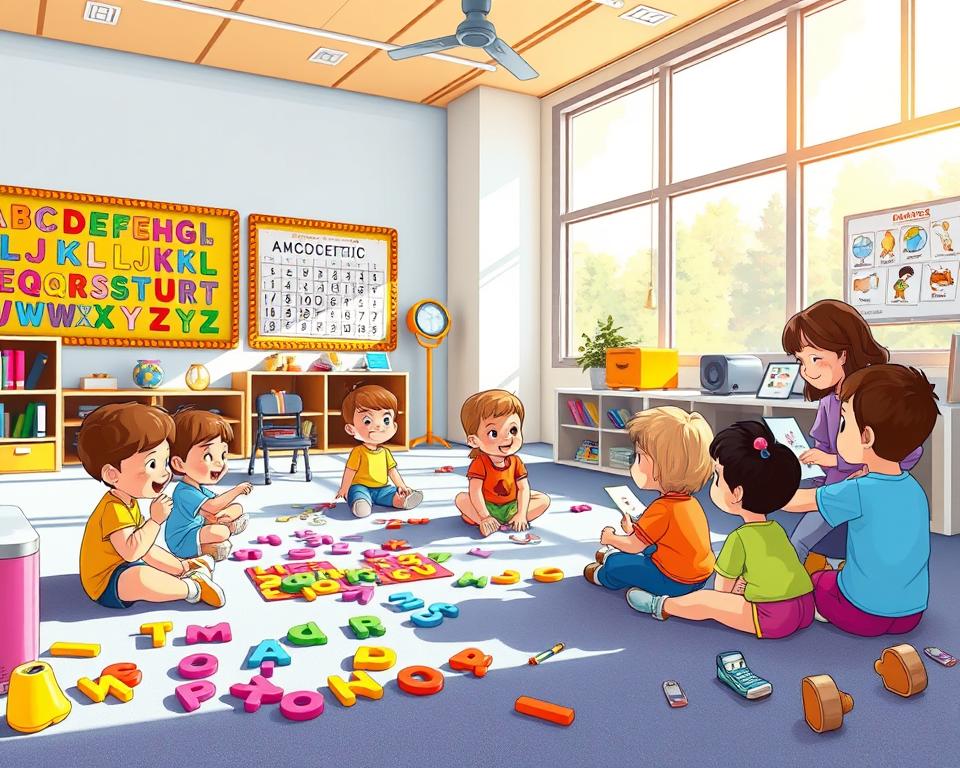
Learning the sounds of English is easier with phonetic alphabet exercises. These activities help improve how we say words and make learning fun. They link letters with their sounds, which is key for reading.
Implementing the Better Alphabet™ Song
The Better Alphabet™ Song is a great tool for teaching letters and sounds. Studies show it boosts alphabet recognition by 30% in kids under ten. It’s a powerful tool for early reading skills.
Integrating Letter Runs into Daily Practice
Letter Runs focus on the sound of each letter, not just its name. This helps kids learn to read faster. It’s especially helpful for ESL learners, speeding up their language skills by up to 35%.
Visual Aids to Support Sound and Symbol Integration
Flashcards with letters and sounds help adults learn faster, by 15%. They make it easier to connect sounds with letters. This is crucial for reading skills.
Using alphabet resources can also improve learning by 25% for English learners. These tools are vital for teachers and families to create a strong learning environment.
| Phonetic Exercise | Improvement in Learning Outcome | Target Audience |
|---|---|---|
| Better Alphabet™ Song | 30% increase in alphabet recognition | Children under age 10 |
| Letter Runs | 35% faster language acquisition | ESL Learners |
| Flashcards with Phonetic Transcriptions | 15% faster recognition speed | Adult Learners |
The International Phonetic Alphabet (IPA) and Alphabet in Phonetics
The International Phonetic Alphabet (IPA) is a detailed system for writing sounds in languages. It helps people learn how to say words correctly and communicate clearly worldwide. The IPA has special symbols for each sound found in different languages.
Breaking Down the IPA for Clear Communication
The IPA was created in 1888 by the International Phonetic Association. It helps write down speech sounds in a consistent way. It’s not just for English; it covers sounds from all over the world.
It’s updated often, with big changes in 2005. Now, it has 107 letters and 31 diacritics to change these sounds. It also has 17 signs for things like tone and stress. These updates keep the IPA useful for language experts everywhere.
Exploring the IPA Diacritics for Precise Pronunciation
Diacritics in the IPA change the sound of letters. For example, they can show if a sound is nasalized or aspirated. This is key for correct pronunciation in many languages.
The IPA also has symbols for tone, stress, and intonation. These help learners and experts understand the details of spoken language. It’s vital for speech-language pathologists and actors who need exact sound transcriptions.
Learning the IPA through online tools or professional apps is very helpful. It teaches people how to handle the complexities of languages with confidence and precision.
Articulating Accurate Sounds with Alphabet Phonetics
Learning to make sounds correctly is key for good communication and language skills. A phonetic transcription chart and a detailed pronunciation guide are great for both learners and teachers. They help us understand phonetic language better.
Using a phonetic transcription chart helps us see and practice sounds linked to symbols. This is very important in English, where small sound changes can change word meanings. The International Phonetic Alphabet (IPA) is a standard way to write phonetic sounds, making it essential for studying phonetic languages.
It’s also important to know about diacritics like the acute accent and the tilde. They change the sound quality or length, helping us pronounce vowels and consonants right. Here are some examples:
- Vowels like A, E, I, O, U can have different sounds, changing word pronunciation a lot. This depends on where they are and any diacritics they have.
- Consonants are grouped into voiced, voiceless, and semi-vowels. Each group has a unique role in making words and phrases.
Another important thing is knowing that sound pronunciation can vary. For example, 40% of Americans say “cot” and “caught” the same way. This affects how we understand words.
By using phonetic language tools and practicing regularly, we can get better at speaking clearly. This is important for everyday talk, public speaking, acting, and singing. Making sounds right helps us communicate better, reducing misunderstandings in all areas of life.
So, learning phonetic language through alphabet phonetics is not just for school. It’s a journey that makes us better at speaking and understanding others. It improves our language skills and how we communicate with everyone.
Transformative Alphabet Learning Techniques
Learning phonetics and phonemic symbols has changed how teachers teach the alphabet. They use methods like “A to Z in Three” and Decoding Dictionaries. This helps students learn and understand phonetics better.
“A to Z in Three” Approach for Rapid Acquisition
This method links phonetics to fun and memorable activities. Visual aids, used in places like California’s orange ranches and Brazil’s sugarcane farms, help students connect sounds with their world.
Implementing Decoding Dictionaries and Porta-Pics
Decoding Dictionaries and Porta-Pics let students practice phonetics hands-on. These tools help students learn the sounds and symbols of phonetics. This method is inspired by successful literacy projects.
Here’s a comparison showing how these techniques help students master phonetics.
| Technique | Description | Outcome |
|---|---|---|
| Visual Aids | Incorporation of real-life images and thematic decorations to reinforce phonetic concepts. | Improved retention and application of phonetics pronunciation guide in diverse learning environments. |
| Decoding Dictionaries | Tools for students to create personal connections with phonemic symbols and their uses. | Enhanced student ability to decode complex phonetic patterns and foster reading comprehension. |
| Porta-Pics | Portable visual aids that provide constant reinforcement of phonetics concepts. | Increased engagement and interest in phonetic learning, leading to higher literacy rates. |
| ‘A to Z in Three’ | Intense, short-term focus on phonetic awareness through immersive activities. | Significant progress in learning letter names and sounds, particularly among early learners. |
These educational methods help students learn phonetics well. They also prepare students for future success. Through interactive and engaging materials, students become skilled in language. They become confident communicators and thinkers.
Supporting Orthographic Mapping in Young Brains
Orthographic mapping is key for students to link sounds to letters and patterns. This helps them read words quickly and easily. It starts with knowing the phonological alphabet and using phonetic transcription examples.
Using the Alphabet to Foster Reading and Writing Skills
Teaching young learners the alphabet through phonetic dictionaries and phoneme charts boosts their reading and writing. By second grade, they should be able to read and understand words well. This comes from learning phonics and practicing phonemic awareness.
Role of Phonics in Early Childhood Development
Phonics is very important in early learning. It teaches the basics of the phonological alphabet and how sounds relate to letters. This foundation is crucial for reading and writing skills later on.
Here’s how these strategies help young learners:
| Statistic | Explanation |
|---|---|
| 30,000 to 60,000 words | Adult readers know up to 60,000 words well, making reading easy. |
| One to four exposures | Students can learn to read words quickly after seeing them 1-4 times by grade 2. |
| Third-grade skill consolidation | By third grade, students get better at reading through lots of practice. |
Using decoding, grapheme-phoneme knowledge, and phonemic awareness in daily lessons is key. Tools like phoneme charts and phonetic dictionaries help show these connections. They support young learners in becoming better readers and writers.
Advancing Beyond Basics: Diving into Diacritics
Those who have learned basic phonetic transcription are ready for more. Exploring diacritics in phonetics language is the next big step. Diacritics show the small details in sounds that are key for clear communication in many languages. It’s crucial for ESL students who want to improve their pronunciation.
Using a phonetic transcription converter makes learning easier. These tools show how text turns into speech sounds with special marks. These marks show tones, stress, and length. It helps learners improve their phonetic notation and understand phonetics better.
Let’s see how diacritics change pronunciation, using common vowels and stress markings:
| Vowel | Example With Diacritic | Pronunciation Change |
|---|---|---|
| A | Ā (long A) | Changes from ‘cat’ to ‘cart’ |
| E | È (grave E) | Changes from ‘bet’ to ‘bate’ |
| I | Í (acute I) | Changes from ‘fit’ to ‘feet’ |
| O | Ō (long O) | Changes from ‘not’ to ‘note’ |
| U | Ü (umlaut U) | Changes from ‘cut’ to ‘cute’ |
Phonetics can seem hard at first, but with the right tools and approach, you can master it. Using a phonetic transcription converter makes learning diacritics easier. It lets learners focus on using them rather than just memorizing them. This, along with phonetics language courses, helps learners move forward smoothly.
For those who speak English as a second language, learning these advanced phonetic elements can greatly improve their speaking. Courses that guide learners through phonetic transcription, with visual aids and support, make it achievable. It’s no longer just a big challenge.
Practical Tips for Engaging with Alphabetical Phonetics
Adding the phonetic sounds alphabet to your teaching can change how students learn. Using phonetic transcription symbols and a strong phonetic system helps students quickly understand phonics. Here are some ways to make learning more fun and effective.
Interactive Games and Reward Systems in Learning Phonetics
Games that use the phonetic sounds alphabet make learning fun. Games like ‘Phoneme Pop’ and ‘Sound Match’ let students play with phonetic symbols in a fun way. Adding rewards like stickers or certificates for learning new sounds makes learning exciting.
- Phoneme Pop: A game that challenges students to burst bubbles containing letters after hearing the phonetic sound.
- Sound Match: Students match cards based on phonetic sounds, encouraging sharp listening and recognition skills.
Customizing Phonetic Learning for Individual Needs
Every student learns at their own pace with the phonetic system. Tailoring lessons to focus on specific sounds or symbols helps each student. Activities like using sand trays or LEGO blocks make learning phonetic concepts fun and memorable.
- Trace Writing in Sand: Enhances tactile feedback while practicing letter formation.
- Building Words with LEGO: Combines fun and education, reinforcing the phonetic sounds of letters and improving hand-eye coordination.
Changing teaching tools and strategies for each student’s needs improves learning. It makes learning the alphabet both fun and educational.
The Alphabet in American Sign Language (ASL)
The ASL alphabet sign language is key to American Sign Language. It helps people who are deaf or hard of hearing talk and understand each other. It’s also great for teachers, interpreters, and anyone who wants to learn more about sign language.
The ASL alphabet has 26 letters, each with its own handshape. It’s the first step to learning this rich language. It helps spell out names and words when there’s no direct sign. This is very useful in school or when giving presentations.
| ASL Component | Description | Benefit |
|---|---|---|
| Handshapes | 22 distinctive shapes representing different letters | Facilitates fine motor skills and memory retention |
| Fingerspelling Proficiency | Ability to recognize and produce letters and words | Enhances vocabulary and clarity in communication |
| Challenging Letters | Specific techniques for clear signing of hard to distinguish letters | Improves accuracy and understanding in ASL literacy |
| Cultural Significance | Used widely across various settings | Encourages cultural inclusivity and awareness |
There are fun ways to practice the asl signs alphabet. Try fingerspelling words you see every day. Or, challenge yourself with harder words. These activities make learning ASL fun and interactive.
The alphabet in american sign language is very important. It helps make communication easier for everyone. Learning ASL’s alphabet can help you grow personally and professionally. It also makes places more welcoming for everyone.
Conclusion
The journey into the phonetic alphabet for English is a deep dive into the sounds that make up our language. The English alphabet has 26 letters and shows 44 different sounds. Learning these sounds is key for education, better communication, and career growth.
By mastering the phonetic interpretation, we gain tools that deepen our understanding of language. These skills are not just for school; they help us communicate clearly and effectively.
To speak the pronounce alphabet sounds right, we need to know about short vowels, diphthongs, and consonant sounds. The International Phonetic Alphabet (IPA) and the NATO phonetic alphabet help by using clear codes. They make sure we’re understood, whether in class or on the radio.
Using different teaching methods, like pictures and songs, makes learning fun and effective. These methods help kids learn to read and speak well. They prepare them for a future where they can communicate well in both words and writing.
Exploring the English language shows us its many sounds and ways of speaking. The IPA helps us capture these differences. Learning phonetics is not just about school; it’s a way to understand and share human expression.
FAQ
What is the alphabet in phonetics?
The alphabet in phonetics is a system of symbols for speech sounds. Each symbol stands for a specific sound. This helps in understanding and pronouncing different languages.
How can the phonetic alphabet improve communication?
The phonetic alphabet uses a standard set of symbols for all sounds. This helps people from different languages or dialects to clearly share pronunciations. It reduces misunderstandings, especially in multicultural settings.
What is the purpose of phonetic transcription?
Phonetic transcription shows the sounds of speech visually. It helps teach and learn pronunciation. It also aids linguists in analyzing spoken language and helps language learners.
Why are phonetic symbols important?
Phonetic symbols clearly show speech sounds, unlike word spellings. They help linguists, teachers, and students discuss and analyze pronunciation without confusion.
How do sound-symbol relationships aid in learning to read?
Sound-symbol relationships are key in phonics. They show how letters and letter combinations relate to sounds. This is crucial for decoding and encoding words.
What role does muscle memory play in learning phonetics?
Muscle memory makes learning phonetics automatic. It helps learners quickly recall sounds when reading and writing. This is due to muscle memory’s reflexive responses to letters and sounds.
Are there any advantages to using music when teaching the alphabet?
Yes, music makes learning the alphabet and its sounds fun. Melody and rhythm improve memory and make learning engaging. Music provides a memorable way to learn letter sequences and sounds.
How does understanding vowels and consonants impact literacy?
Knowing vowel and consonant sounds is vital for reading and spelling. Literacy depends on these sounds to form words and follow grammar rules.
Can you provide examples of practical phonetic exercises?
Exercises like the Better Alphabet™ Song and letter runs are effective. They focus on sounds over names and encourage practice. This makes learning phonetics interactive and fun.
What is the International Phonetic Alphabet (IPA)?
The International Phonetic Alphabet (IPA) is a system for representing speech sounds. It was created by linguists to accurately show each sound. It’s used for transcribing any language’s sounds.
How can phonetic learning be customized to individual needs?
Learning phonetics can be tailored with personalized flashcards and exercises. Technology allows for adjusting instruction to fit individual learning styles and challenges.
What benefits are associated with learning the ASL alphabet?
Learning the ASL alphabet improves fine motor skills and non-verbal communication. It also opens up communication with the deaf and hard of hearing. It’s a step into American Sign Language, enhancing cultural awareness and communication skills.

